
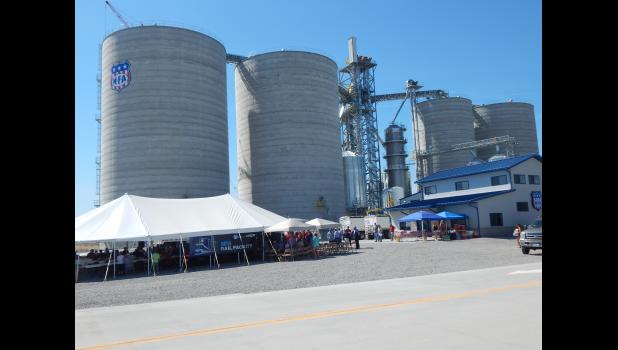
MFA Rail Facility and what it means to area farmers

by Cindy Fickess
A two-day open house was held June 20 and 21 at MFA’s new rail facility. Those attending the open house heard from company officials, watched a grain dumping demonstration (see video), took a tour of the facility, and were treated to a delicious BBQ lunch prepared by Bill Englert of Hamilton.
The Hamilton Rail Facility is the largest project in MFA history and is just 4.9 miles east of Hamilton. The making of the facility took five years of searching, scouting, analyzing and designing, and above all, team effort of all those involved to make the project successful. The size of the facility as seen from Highway 36 is impressive, but when taking a closer look, the massive grain bins and adjoining structures are truly a site to see. Ernie Verslues, President and Chief CEO of MFA, said of the project, “In my mind, it represents a change in the skyline for Caldwell County. It also represents a change in MFA’s approach to the grain business.” Verslues explained that 30 years ago, grain had not been the core focus of the company, but under the leadership of the company’s two previous CEOs, the focus changed and the company once again recognized that there was a financial benefit both to MFA Inc. and to the producers in the area of grain.
The facility is conveniently located just off Highway 36, is in close proximity to Interstate 35, and will have direct access to the Union Pacific Railroad. The rail siding or “loop-loader” is in a circle connected to the main line and accommodates a 110-car “shuttle train.” The shuttle train will hold approximately 420,000 bushels of corn or 380,000 bushels of soybeans and can be loaded in fewer than eight hours. The facility can move 60,000 bushels per hour as farmers deliver their grain.
Mitch Dawson, MFA Incorporated’s Director of Grain Operations, reflected on the change in farming operations of just 10-15 years ago. With advancement in seed genetics and planting and harvesting technologies, farm production has increased and MFA has had to evolve as well. Dawson said that, “Now what you want and expect from us, especially when it comes to harvest is speed, speed and more speed, right? We wanted to make sure that what we were going to come up with would fit farmers today and to think about what farmers would be needing in the future.” So, MFA began an in-depth analysis in 2013-2014 and started getting financial information together. MFA engineering became involved in the spring of 2014, the business plan was refined in 2015, and they then talked to the Caldwell County Commissioners for approval.
Darren Harris was an excellent tour guide and provided a lot of information at the top of his head. Following are some of those interesting facts about the facility:
The project in its entirety accumulated over 13,000 cubic yards of concrete and of that total, the four silos amassed 8,000 cubic yards, and there were two million pounds of steel in those four tanks.
The facility contains a dust collection unit which collects dust off both pits, the dust will travel through a large pipe to a bag house containing a series of hanging bags that will clean the air. In addition to the dust collection, the system has a mineral oil tank. The oil will be added to the grain as it drops into the legs at one gallon per 1,000 bushels of grain. The grain dryer will handle 4,700 bushels of grain per hour, pulling off 5 points of moisture, which would be like 20% down to 15%. The dryer has a 47 million btu burner in it compared to the burner in an average furnace of 100,000 to 120,000 btu. There are three fans in the dryer that are 75 hp each that blow hot air up and out, and pull air from the bottom of the column to cool the grain enough so it can go into a grain bin without having the need of special air. The fans have mufflers to reduce noise. Harris said that in order to get a permit to build this facility, DNR and the EPA require you to get a permit, do a lot of studies on dust and how much dust they need to site. “They even make us site how much dust comes off our haul road, that’s why we have concrete, because if we had a gravel road and we had so much dust come off that in addition to the grain bins, we would exceed the limit allowed,” said Harris.
The electrical room handles around 4,000 hp. Every motor is on a variable frequency drive which controls the speed at which the motor runs. By changing the frequency, you can change the speed of a motor taking it to half the speed. The benefit of that is to give the motors a soft start. Harris explained that the legs have twin motors which amount to a lot of horsepower to have to start at once.
A computer in the control room monitors all the various equipment on the site and tells what is running, the speed and capacity it is running, and controls the Program Logic Controller which controls the various frequency drives. “This currently is a state of the art facility,” said Harris.
The loop track is still waiting completion. Workers had to move about 700,000 cubic yards of grade work, the deepest cut was 42’ and the deepest fill at the southwest corner was around 30’. The loop is 7,700 feet long and is as flat as a tabletop. They are only allowed a 2.2% slope per 1,000 ft. Employees are given 15 hours to load a train. Harris said, “If you do it in less than 15 hours, there are incentives from the railroad to make extra money in that process that’s why we are loading it out so fast, to make sure we can do it in 15 hours.
When asked what farmers will gain from the project, Mitch Dawson said that transportation would be a major factor, as many farmers in this area take grain to Kansas City. This will also help save time, especially during harvest season. The 110-car shuttle will give MFA the opportunity to hit markets they couldn’t get before from Mexico, Texas, Arizona, to the west coast, and even to New Orleans. MFA put capital into the project to be able to serve their own elevators, farmers in the area, and they can buy grain from other elevators as well. “This project is for the whole region,” said Dawson.
MFA currently has six employees from Stewartsville, Maysville, two north of Cameron, Amity, Union Star, mostly in DeKalb County. They have one more full-time position available and will need to hire seasonal help as needed.
MFA’s new Petro Facility is scheduled to open September 1.
